

Telecom networks are transitioning from traditional, hardware-based IP Multimedia Subsystem (IMS) deployments to cloud-native IMS architectures that leverage microservices and are orchestrated using Kubernetes. While this evolution enables greater scalability, resilience and conforms to cloud native principles, it may increase operational complexity. To manage these dynamic environments efficiently, automation has become a critical component of IMS operations as well as the cloud platform.
Rising operational expenses (OPEX) driven by manual configuration, maintenance and troubleshooting across multiple network functions highlight the growing need for operational efficiency. Automation tackles these challenges by reducing repetitive tasks and improving overall resource utilization, while also minimizing downtime and service disruptions. As operators face mounting pressure to deliver new services faster, automated deployment pipelines, configuration management and testing frameworks enable quicker rollouts and updates without compromising service quality.
Automation also introduces much-needed elasticity to the network, allowing IMS components to dynamically scale based on real-time traffic demands. This ensures optimal performance during peak hours while preventing unnecessary over-provisioning during off-peak periods. By limiting manual intervention in critical workflows, automation drastically reduces human error and strengthens network stability and reliability. It is no longer a value-add but a fundamental requirement for achieving cost-efficient and future-ready IMS operations. Additionally, the configurations of IMS with all the capabilities and provisioning of millions of subscribers to the new platform is a labor intensive task. Automation is necessary to provision new subscribers or migrate them from the old platform, and modify configurations and services to suit their needs.
Having established the need for automation in IMS operations, it is essential to understand how it is applied within modern, cloud-native architectures. Automation extends beyond simple task execution to encompass the entire service lifecycle from engineering and deployment to monitoring and scaling. It define show IMS components operate with minimal manual intervention.
Automation in IMS can be observed at different maturity levels, depending on the degree of human involvement and system intelligence:
Automation for IMS consists of two key areas.
Infrastructure or platform automation is managed via Kubernetes to manage microservices, onboarding, self healing, desired state operations etc.
Application automation consists of application lifecycle management, upgrade and updates, config and rollback as well as new component of service spawning based on workflow of system status. This is done in ng-voice IMS via the control tower where the control tower can keep track of service level KPIs and do infrastructure adjustments to manage the overall service quality better.
Automation also spans multiple operational areas, each contributing to efficiency and reliability. Some examples are listed below:
The cloud-native IMS architecture is inherently designed to support and simplify automation. By structuring IMS functions as independent microservices packaged in containers, telecom operators can manage and update each function separately. Orchestration environments such as Kubernetes enable configuration, autoscaling, fault recovery and rolling updates. This modular architecture not only streamlines day-to-day operations but also lays the foundation for advanced capabilities such as self-healing and closed-loop automation.
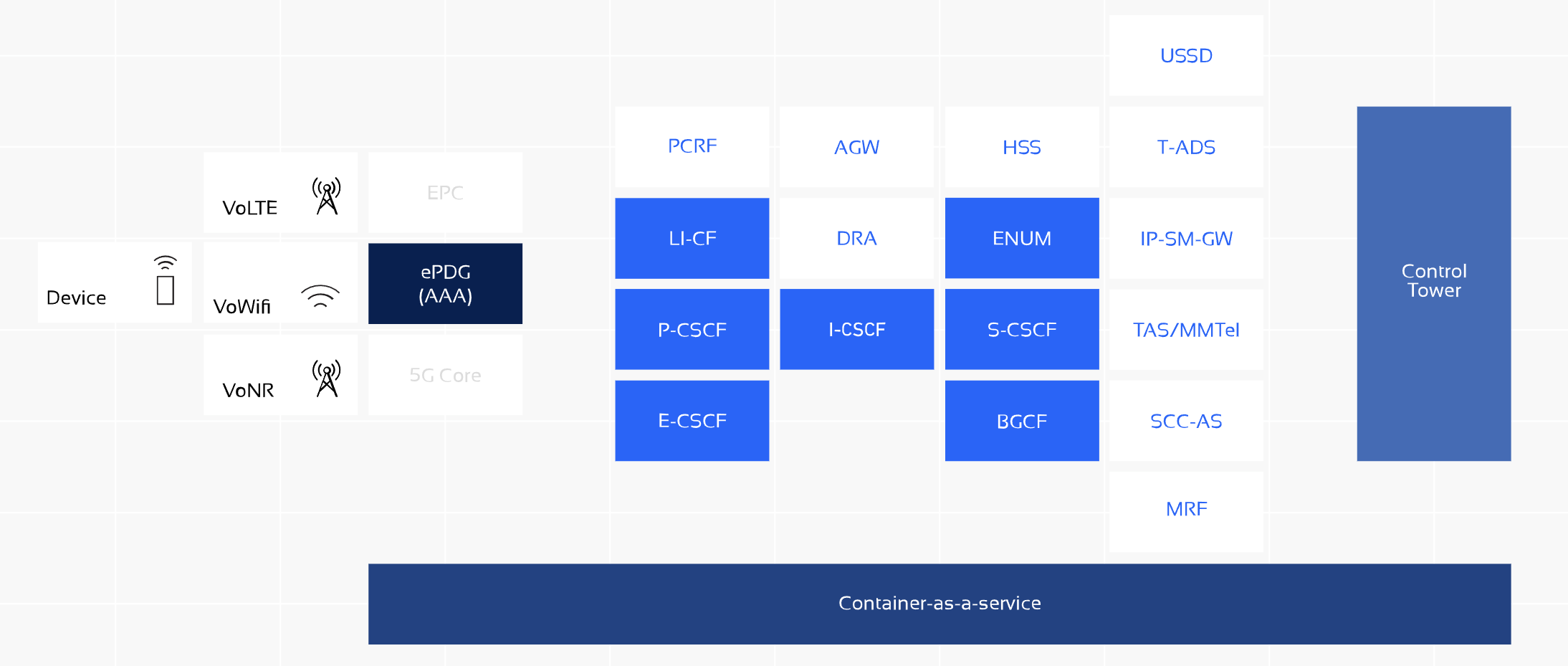
ng-voice’s Hyperscale IMS is designed with automation at its core enabling CSPs to operate highly available, cost-efficient voice networks with minimal manual intervention.
The ng-voice Hyperscale IMS is built on a microservices-based architecture that enables real-time autoscaling across all network functions. When traffic increases, the Kubernetes controller dynamically scales only the components that have reached their defined thresholds on CPU or memory, ensuring optimal performance and efficiency without over-provisioning. Additionally, ng-voice IMS also leverages the KEDA (Kubernetes Event Driven Autoscaling) project to scale IMS components based on custom metrics such as number of sessions, traffic thresholds, busy hour or other parameters. When demand decreases, the system scales down gracefully within minutes to free up unused resources without tromboning of traffic. With full on-demand scalability, operators can achieve up to 70% lower total cost of ownership (TCO).
At ng-voice, we are redefining how Communication Service Providers (CSPs) manage their voice networks by combining our truly cloud-native IMS architecture with generative AI capabilities. Using natural language interfaces, operators can query configuration information, network performance data, detect anomalies and initiate corrective actions in real time. This approach minimizes downtime, optimizes resource utilization, and significantly reduces operational complexity unlocking new levels of efficiency for Voice over LTE (VoLTE) and Voice over New Radio (VoNR) services.
The ng-voice Hyperscale IMS incorporates self-healing capabilities through tight integration with Kubernetes, ensuring continuous, carrier-grade service availability. When deployed, the solution is configured with a desired state that defines the minimum number of pod instances required to meet baseline traffic demands. Kubernetes controllers continuously monitor the system and compare the actual runtime state against this desired state.
If failures occur, for example due to node failures (e.g. a hardware failure) or containers failing liveness health checks, the actual state will fall below the desired state. Kubernetes automatically detects this condition and, within seconds, schedules replacement pods on healthy nodes to restore service capacity. In the case of readiness probe failures, affected pods are removed from service and no longer receive traffic, protecting active sessions while remediation takes place.
This cloud-native design allows the IMS to recover seamlessly from infrastructure and application-level faults rapidly and without manual intervention. By combining a distributed microservices architecture with Kubernetes’ control mechanisms, the ng-voice IMS reduces single points of failure and delivers the resilience and stability expected of carrier-grade voice services.
Continuous improvement is embedded into ng-voice’s operational framework. The Hyperscale IMS supports seamless software updates and upgrades through CI/CD pipelines and Kubernetes-based rolling deployments. This enables operators to introduce new features, patches and performance enhancements without downtime or service disruption. Because each network function runs independently as a containerized service, updates can be applied selectively, maintaining overall network stability while accelerating innovation and time-to-market.
Through these automation capabilities, ng-voice enables CSPs to maintain high availability, lower OPEX and achieve operational consistency across diverse network environments.
The automation capabilities of ng-voice IMS are leveraged in a wide range of practical applications across different domains. From protecting subscribers with Call Shield, facilitating IoT communications and ensuring Disaster Recovery. These use cases demonstrate how ng-voice’s cloud-native IMS can deliver operational efficiency and create new revenue opportunities for operators. Each use case leverages automation to simplify management and provide measurable value to both operators and end-users.
In addition to infrastructure or platform level automation, here are some use cases where application and service level automation are demonstrated where ng-voice application, due to its built in automation capabilities drives new features and services for telecom operators.
Call Shield is ng-voice’s intelligent and automated spam protection framework designed to protect both consumers and enterprises from robocalls and other fraudulent traffic. Leveraging automation, Artificial Intelligence (AI) and Machine Learning (ML), it continuously detects, blocks and adapts to emerging threat patterns in real time. By analyzing live call logs and applying advanced pattern recognition, Call Shield automatically identifies spam and scam traffic without the need for manual updates or intervention. The system dynamically refreshes block lists, prevents Denial-of-Service (DoS) attacks, safeguards enterprise communication and strengthens overall network reliability and trust.

For service providers, this automation translates into tangible business and regulatory benefits:
By combining automated threat detection with real-time adaptation, Call Shield not only protects networks and users but also creates new business opportunities for service providers. It strengthens consumer trust and ensures regulatory compliance, making it a critical value-added service within the ng-voice IMS ecosystem.
Learn more about Call Shield here: Call Shield
The ng-voice IMS supports a range of IoT use cases through a flexible, cloud-native architecture based on VoLTE and IMS connectivity. Compared to traditional mass-market voice traffic, these use cases place distinct demands on the network, as communication is typically infrequent but mission-critical. Key examples include:
Such IoT deployments involve a very large number of registered endpoints with minimal call activity, yet strict emergency call requirements mean the network must remain continuously available and cannot tolerate silent failures or undetected outages. As a result, the IMS layer must be automatically and continuously verified even during periods with no active calls. ng-voice’s cloud-native IMS addresses this by periodically testing and validating individual network components in the background, ensuring the network is fully operational when an emergency call is placed.

While operator outages are rare, their impact can be significant. The ng-voice IMS leverages a cloud-native architecture to provide cost-effective and resilient disaster recovery (DR) solutions.
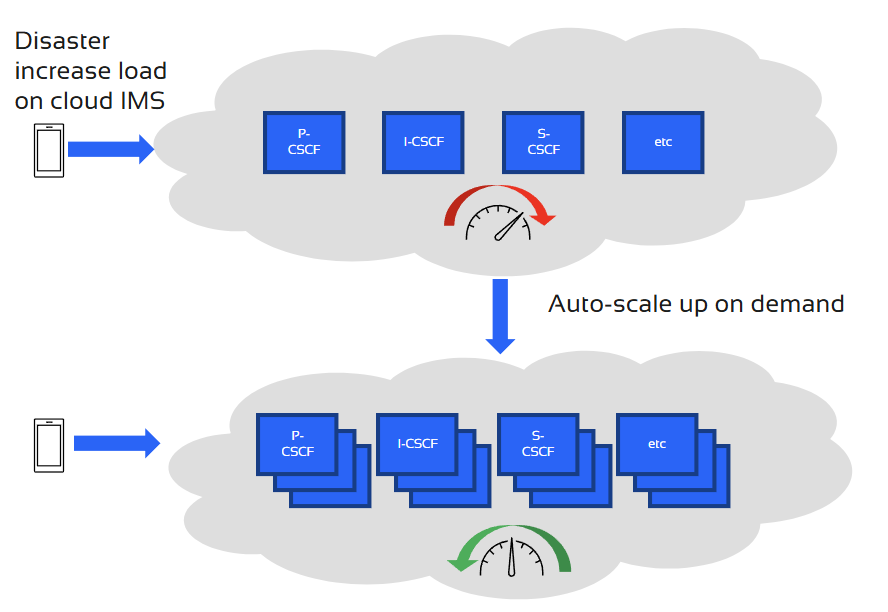
Key benefits include:
Learn more about Disaster Recovery here: Cloud-based disaster recovery for telecoms networks
While ng-voice IMS offers a range of advanced automation capabilities across multiple use cases, managing and orchestrating these functions efficiently requires a centralized operational view. The ng-voice Control Tower provides this unified interface, enabling operators to deploy, integrate, test, monitor and troubleshoot the Hyperscale IMS from a single dashboard. With Helm-based management of Kubernetes clusters, real-time KPI monitoring, automated health checks and end-to-end testing of each IMS component, the Control Tower ensures that all automated processes across use cases are coordinated and executed with maximum efficiency. Control Tower is the central automation hub of ng-voice IMS that can define workflow, thresholds and triggers, scaling policies, periodic and automated testing etc.
Key capabilities include:
By consolidating these functions into a single interface, the Control Tower streamlines IMS operations and reduces human effort, making it a strategic asset for operators delivering next-generation voice services.
Learn more about ng-voice’s Control Tower here: The ng voice Control Tower - a command center for the Hyperscale IMS
The cloud-native design of the ng-voice IMS with built in automation, delivers clear operational and business advantages for operators and CSPs. Reduced manual intervention and optimized resource allocation lowers OPEX and CAPEX, while automated deployment, autoscaling, and self-healing improve reliability and service continuity. A flexible and infrastructure-agnostic architecture enables deployment across on-premises, public cloud, or hybrid environments, and centralized tools like the Control Tower provide unified visibility and streamlined management of complex networks.
These capabilities help operators deliver reliable, scalable voice services while efficiently managing diverse use cases. By reducing operational complexity and providing greater visibility and control, ng-voice’s Hyperscale IMS supports more resilient and cost-effective network operations.
Looking ahead, the integration of GenAI-based assistants and agents offers a path toward further operational efficiency. Predictive insights, real-time troubleshooting support, and context-aware guidance can enhance automation and proactive network management. Early exploration of Agentic AI presents opportunities for iterative reasoning and autonomous decision-making, paving the way for more intelligent and adaptive telecom networks in the future.
Automation is required to manage dynamic, cloud-native IMS environments where network functions scale, heal and update continuously.
In the ng-voice Hyperscale IMS, network functions are built as independent microservices with well-defined interfaces and health checks. Kubernetes orchestrates these services for automated deployment, scaling, and recovery, while the ng-voice Control Tower provides centralized control to define workflows, policies, and operational automation across the IMS lifecycle.
Legacy IMS platforms rely on tight coupling manual workflows, which limits observability and prevents automated lifecycle management across individual network functions.
Automated scaling ensures IMS resources are allocated only when required and released automatically during low traffic, preventing over-provisioning and reducing operational costs.
Automation enables real-time fault detection, isolation, and recovery and is driven by Kubernetes. Failed components restart and are automatically replaced or removed from traffic without manual intervention.
Autoscaling allows the IMS to automatically adjust capacity based on real-time traffic and KPI thresholds. Network functions scale up within seconds during demand spikes and scale down when traffic subsides, ensuring consistent performance while avoiding overprovisioning and unnecessary resource consumption.
Automation ensures the IMS is continuously verified even during periods with little or no active traffic. Through automated background testing and validation of individual network components, the system detects silent failures early and ensures the network is fully operational when a mission-critical or emergency call is placed.
Automation ensures consistent collection of network performance data and enables predefined actions to be executed reliably. This allows GenAI-based interfaces to query live IMS system, detect anomalies, and initiate corrective actions in real time, reducing manual effort and operational complexity.
Automation reduces manual workload, mean time to repair (MTTR), and operational overhead, allowing teams to focus on optimization rather than firefighting.
